Overview
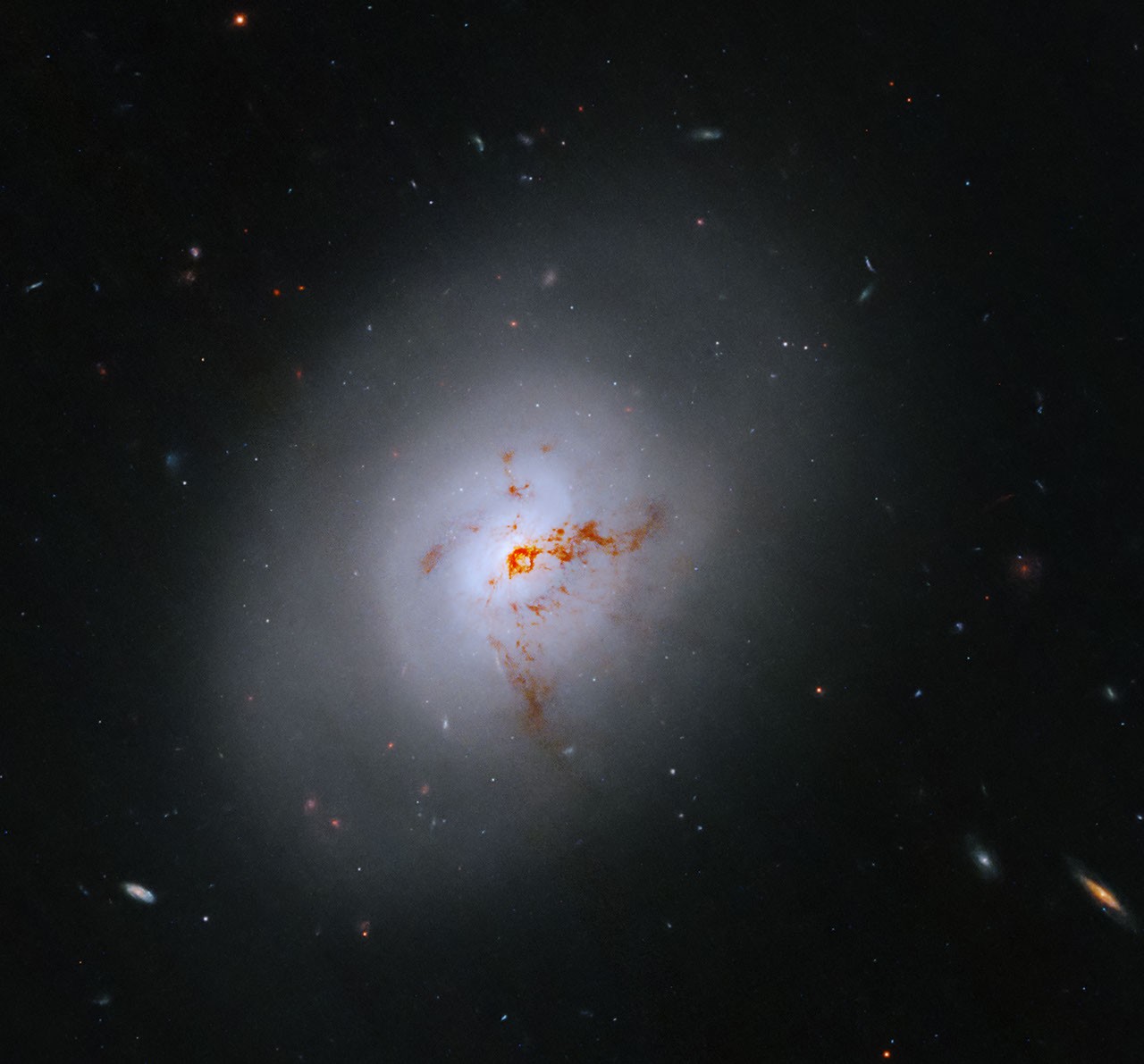
Galaxies are not static; they evolve over billions of years. One of the most fascinating stages in galactic evolution is the transition from a vigorous star-forming spiral to a quiescent elliptical. The lenticular galaxy NGC 1266, imaged by the NASA/ESA Hubble Space Telescope, offers a rare snapshot of this transformation in progress. Located about 100 million light-years away in the constellation Eridanus, NGC 1266 is a post-starburst galaxy — a class that makes up only about 1% of local galaxies. This tutorial explains what makes NGC 1266 special, how astronomers classify it, and what we can learn from its transitional state.
Prerequisites
Before diving into this guide, you should be familiar with:
- The Hubble sequence (classification of galaxies into spiral, elliptical, and lenticular types).
- Basic concepts of star formation and active galactic nuclei (AGN).
- How telescopes like Hubble capture images in visible and near-infrared light.
No advanced mathematics is required, but a curiosity about cosmic evolution will help.
Step-by-Step Instructions
Step 1: Identify the Galaxy's Morphology
Start with the Hubble image (available at the top of this article). Look for the following features of NGC 1266:
- Bright central bulge: A dense, round region of old stars.
- Flattened disk: Surrounding the bulge, a disk of gas and dust — but no clear spiral arms.
- Dust lanes: Reddish-brown clumps and filaments crossing the disk, partially obscuring the galaxy's face.
- Diffuse outer regions: The disk fades smoothly into the background, with distant galaxies visible through it.
This morphology is classic for lenticular galaxies (type S0 in the Hubble sequence). They combine a spiral's bulge and disk with an elliptical's lack of arms and low star formation.
Step 2: Classify the Galaxy as Lenticular
To confirm the classification, compare NGC 1266 with known spirals and ellipticals:
- Unlike a spiral (e.g., Messier 101), NGC 1266 has no visible arms.
- Unlike an elliptical (e.g., Messier 87), it has a distinct disk rather than a purely ellipsoidal shape.
- The red color of the bulge indicates older stars; the dust indicates some residual gas.
Astronomers use this visual inspection alongside spectroscopic data to confirm the type. For NGC 1266, the combination places it firmly in the lenticular category — a transitional form.
Step 3: Detect the Post-Starburst Signature
The most intriguing aspect is that NGC 1266 is a post-starburst galaxy. This means:
- It experienced a major burst of star formation in the past (probably 500 million years ago).
- Today, it has a young population of stars but few star-forming regions (low H-alpha emission).
- Its spectrum shows strong Balmer absorption lines (from A-type stars) but weak emission lines.
To identify this, astronomers take a spectrum of the galaxy's integrated light. The signature is a clear indicator that star formation has recently stopped — a key transitional phase.
Step 4: Interpret the Merger History
A minor merger with another galaxy about 500 million years ago triggered the starburst. Evidence includes:
- The central bulge increased in mass, which is typical after a merger.
- Gas was funneled into the supermassive black hole (SMBH) at the center, creating an active galactic nucleus (AGN).
- The AGN appears as a very bright point-like center in the Hubble image.
By combining imaging and spectroscopy, astronomers reconstruct the timeline: merger → starburst → gas consumption/feedback → quiescence. NGC 1266 is near the end of this process, with the AGN still active but star formation fading.

Step 5: Compare with Other Transitional Galaxies
For a complete understanding, compare NGC 1266 to other known post-starburst and lenticular galaxies, such as NGC 404 (Mirach's Ghost) or NGC 5102. Note differences in:
- Age of the starburst (from spectral features).
- Presence and strength of AGN.
- Amount of remaining dust and gas.
This comparative approach helps place NGC 1266 on the evolutionary timeline from spiral to elliptical.
Common Mistakes
Mistake 1: Confusing Lenticular with Spiral or Elliptical
Beginners often mistake lenticular galaxies for either spirals (due to the disk) or ellipticals (due to the lack of arms). Remember: lenticulars have a disk and a bulge but no spiral structure. Ellipticals lack a disk entirely. Use the presence of dust lanes as a clue: spirals have them in arms, lenticulars have them scattered.
Mistake 2: Misidentifying Post-Starburst as Starburst
A starburst galaxy (like M82) is actively forming stars at a furious rate. A post-starburst galaxy has a young stellar population but no ongoing star formation. The key is in the spectrum: starburst galaxies show strong emission lines (H-alpha, [O II]), while post-starburst show strong absorption lines. Don't be fooled by the presence of young stars — the lack of star-forming regions is the giveaway.
Mistake 3: Assuming All Lenticulars Are Post-Starburst
Only a small fraction of lenticulars are in the post-starburst phase. Most lenticulars are simply old, gas-poor galaxies that never had a recent burst. NGC 1266 is special because it shows evidence of a specific past event. Always check spectral data before concluding a galaxy is post-starburst.
Summary
NGC 1266 is a rare lenticular galaxy that has recently (in cosmic terms) undergone a major star formation burst triggered by a minor merger, leaving behind a young stellar population and an active supermassive black hole. By following the steps outlined above — identifying its morphology, confirming its lenticular classification, detecting the post-starburst signature, interpreting the merger history, and comparing with other galaxies — you can understand how this object serves as a key example of galactic evolution. The Hubble image reveals both the beauty and the science behind one of the universe's most dynamic processes: the transformation of a spiral into an elliptical, captured in transition.