Traditional intrusion detection systems have long relied on signature-based methods to flag known threats, but this approach is increasingly inadequate against sophisticated attacks. A new paradigm is emerging, driven by machine learning (ML) and autonomous AI agents that evaluate network behavior in context. Instead of simply asking, "Does this packet match a known signature?" these systems ask, "Does this activity make sense given the environment?" This shift promises more accurate, adaptive, and proactive security monitoring. Below, we explore the key concepts behind this transformation, including tools like SnortML and the rise of agentic AI.
1. What is signature-based intrusion detection, and why is it limited?
Signature-based intrusion detection compares network traffic against a database of known attack patterns or signatures. When a packet matches a signature, an alert is generated. This method is fast and reliable for detecting known threats, but it fails against zero-day exploits, polymorphic malware, or attacks that slightly alter their signature. It also produces many false positives when benign traffic coincidentally matches a signature. Moreover, signature databases must be constantly updated, leaving a window of vulnerability between an attack's emergence and signature deployment. These limitations are driving the shift toward contextual analysis powered by machine learning.
2. How does machine learning improve intrusion detection?
Machine learning (ML) models analyze network traffic to learn what "normal" behavior looks like for a specific environment. Instead of relying on static signatures, ML-based detection flags anomalies—deviations from the expected baseline. This allows the system to detect unknown threats and zero-day attacks that have no known signature. For example, an ML model might notice that a workstation is suddenly communicating with an unusual external IP at odd hours, even though the traffic itself doesn't match a known attack. This contextual understanding reduces false positives and adapts as the network evolves. However, ML models require careful training and can still produce errors if the training data is biased or incomplete.
3. What is SnortML, and how does it fit into this evolution?
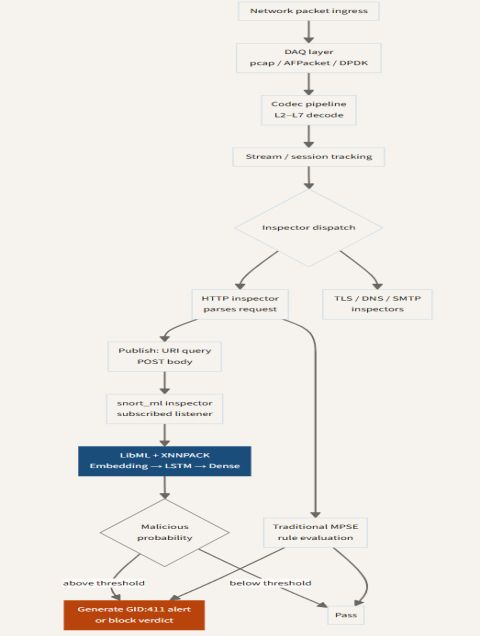
SnortML is an extension of the popular open-source intrusion detection system Snort, integrating machine learning capabilities into its detection engine. Where traditional Snort uses rule-based signatures, SnortML adds a classification layer that can evaluate traffic in real time. It uses models trained on labeled traffic to classify packets as malicious or benign, and it can also flag outliers for further investigation. SnortML supports both supervised models (trained on known attacks) and unsupervised anomaly detection. By combining signature-based rules with ML, SnortML provides a hybrid approach that retains the speed of pattern matching while adding the flexibility of contextual analysis. This makes it a practical tool for organizations transitioning to AI-enhanced security.
4. What does "agentic AI" mean in the context of intrusion detection?
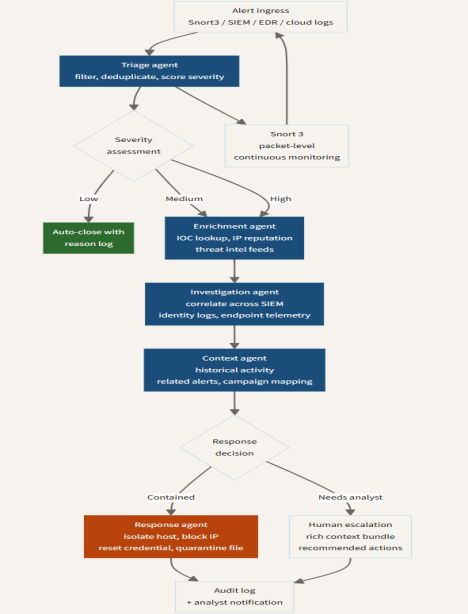
Agentic AI refers to autonomous software agents that can perceive their environment, make decisions, and take actions without human intervention. In intrusion detection, an agentic AI system doesn't just flag suspicious traffic—it actively investigates and responds. For example, an agent might correlate an alert with other data sources (user behavior, asset vulnerability, threat intelligence), escalate a true incident, or even apply a temporary firewall rule to block an attack. These agents operate with a degree of autonomy, executing playbooks and adapting their actions based on new information. This is a shift from passive detection to active defense, where the sensor itself becomes a thinking entity that can make context-aware decisions in real time.
5. How do autonomous agents change the role of human analysts?
With autonomous agents handling low-level triage and response, human analysts can focus on strategic decision-making and complex investigations that require creativity and judgment. Agents can filter out noise—false positives and routine incidents—so analysts only see high-priority events. They can also automate repetitive tasks like log correlation, alert enrichment, and initial containment. This reduces burnout and speeds up mean time to respond (MTTR). However, humans remain essential for defining policies, validating new agent behaviors, and handling edge cases that the AI cannot resolve. The relationship evolves from a manual reaction to a human-AI collaboration, where agents handle the mundane and humans tackle the sophisticated.
6. What are the main challenges of adopting ML and agentic AI for intrusion detection?
Deploying ML and autonomous agents in intrusion detection comes with several hurdles. First, obtaining high-quality labeled data for training is difficult and time-consuming. Imbalanced datasets (few attacks vs. normal traffic) can bias models. Second, ML models can be opaque, making it hard for analysts to trust or explain decisions—a problem especially in compliance-heavy industries. Agentic AI introduces risks of unintended actions: an agent might falsely block legitimate traffic or be tricked by adversarial inputs. Third, computational overhead for real-time inference can strain existing infrastructure. Finally, organizations must have strong governance and monitoring to ensure these systems stay under control. Despite these challenges, the potential for proactive, adaptive security is driving gradual adoption.
7. What does the future hold for intrusion detection architecture?
The future of intrusion detection lies in federated AI where multiple sensors share insights without sharing raw data, enabling larger context without privacy concerns. We'll see more self-healing systems that automatically adjust rules and triggers based on feedback loops. Advanced agentic AI may coordinate across network, endpoint, and cloud layers, creating a unified defense. Additionally, explainable AI (XAI) will become critical to gain trust and meet regulatory requirements. The ultimate goal is an intrusion detection architecture that thinks like a security expert: continuously learning, reasoning about context, and taking decisive yet safe action—while still empowering human oversight.