Introduction
Mistral AI has steadily carved out a reputation for building practical, open-weight coding tools, and its latest release marks a major leap forward. The company has launched remote agents for its Vibe coding platform and introduced Mistral Medium 3.5, a 128-billion-parameter dense model that now serves as the default engine across Vibe and Le Chat. These updates promise to free developers from constant oversight and deliver stronger performance than ever before.
A Closer Look at Mistral Vibe
If you haven’t explored Vibe yet, it’s a command-line interface (CLI) tool that lets an AI model handle software tasks on your behalf. Think of it as a tireless junior developer that can write code, refactor modules, generate tests, investigate CI failures, and more—all across your codebase. Until now, every session ran locally, tying the agent to your terminal and your machine.
The Big Change: Remote Agents
With this update, sessions can now run in the cloud while you step away. You’re no longer the bottleneck. Instead of babysitting every step, you kick off a task and let the infrastructure handle it. You can launch cloud agents from the Vibe CLI or directly from Le Chat, and track progress through file diffs, tool calls, and status updates. Sessions are isolated in sandboxes, so even broad edits and installs won’t affect your local environment.
Teleporting Local Sessions
One particularly useful feature lets ongoing local CLI sessions teleport to the cloud when you want to step away. The entire session history, task state, and any pending approvals carry over seamlessly, so you never lose your place.
Completion and Notifications
When the agent finishes, it can open a pull request on GitHub and notify you via preferred channels like Slack, Teams, or email. This shifts your role from micromanager to reviewer.
Integration and Orchestration
Vibe’s remote agents are built on top of Mistral’s own orchestration layer, called Workflows, within Mistral Studio. What started as an internal tool for Mistral’s own coding needs later became available to enterprise customers, and now anyone can use it. This means the remote coding agent inside Le Chat isn’t a standalone feature—it’s powered by the same system Mistral uses internally.
On the integration side, Vibe connects to:
- GitHub for code and pull requests
- Linear and Jira for issue tracking
- Sentry for incident monitoring
- Slack, Teams, and other apps for reporting
The Model Powering It All: Mistral Medium 3.5
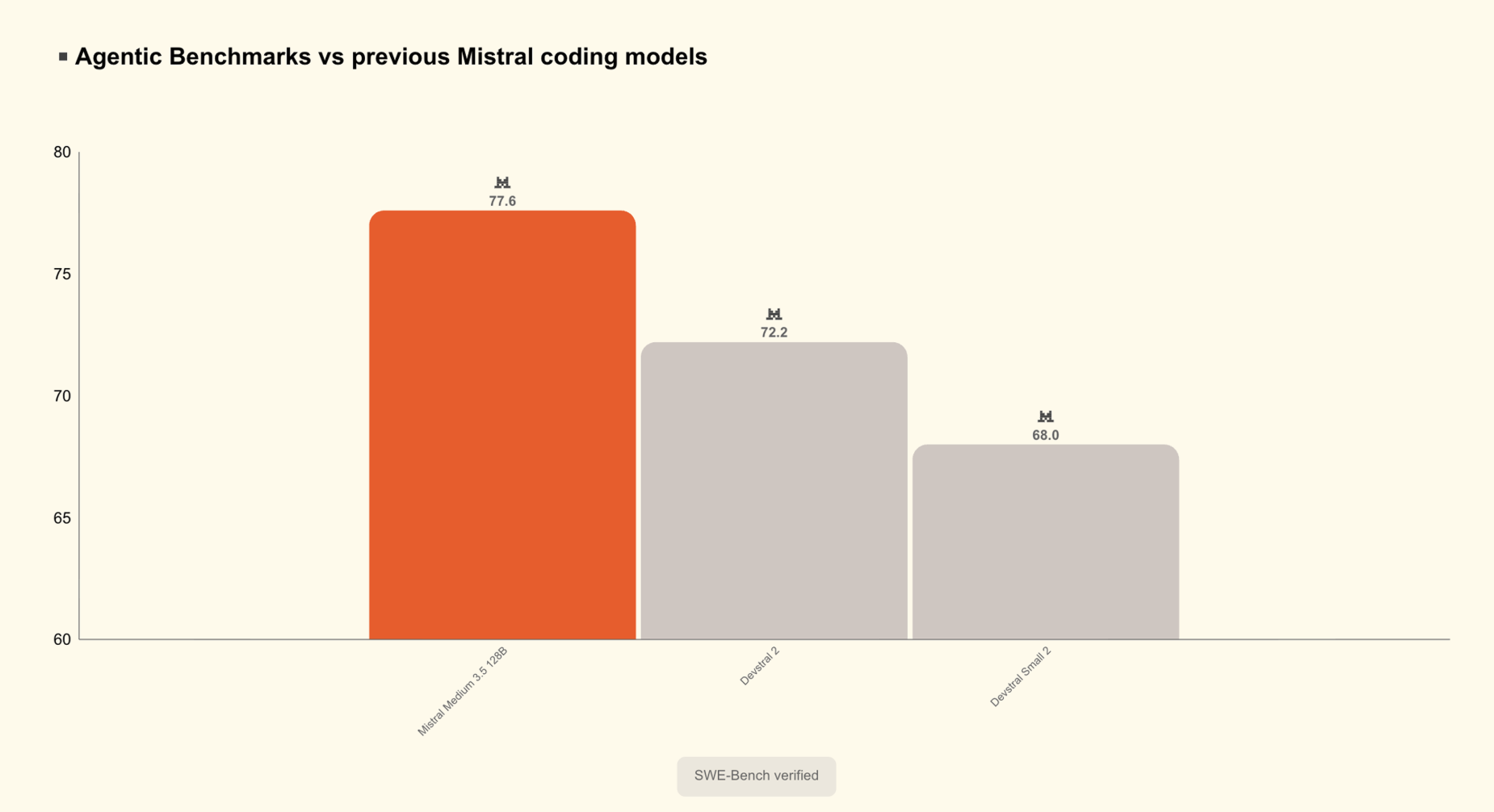
None of this would be practically possible without a capable underlying model. Mistral Medium 3.5 is a 128-billion-parameter dense model that now serves as the default in both Vibe and Le Chat. It achieves a verified score of 77.6% on SWE-Bench, a benchmark that measures real-world software engineering task completion. This indicates strong reasoning and code generation abilities, essential for autonomous agent workflows.
Performance Nuances
The model is designed to handle long, multi-step tasks with minimal errors. Early tests suggest it excels at understanding complex codebases and generating accurate edits. Mistral has positioned this as a direct competitor to models like GPT-4 and Claude Opus, especially in the open-weight space.
Conclusion
With remote agents in Vibe and the upgrade to Mistral Medium 3.5, Mistral AI is making a strong case for practical, autonomous coding assistants. Developers can now focus on higher-level decisions while their cloud agent handles the heavy lifting—whether they’re in the office, at home, or completely offline.